
ERP Questions Finance Teams Should Answer Without a Ticket
The finance questions that should not wait on a data ticket: margin by customer, flux by entity, and the forecast line that no longer matches the ledger.
The Sapien Team
Sapien
Every finance team has a list of questions that are reasonable and still take days. They are reasonable because the ERP already holds the entries. They take days because the answer requires a join, a definition, and a person who is already in the close.
This is for controllers and FP&A leads. The standard to aim for: the questions below get an answer the team can trace, without a ticket to a data queue.
The questions
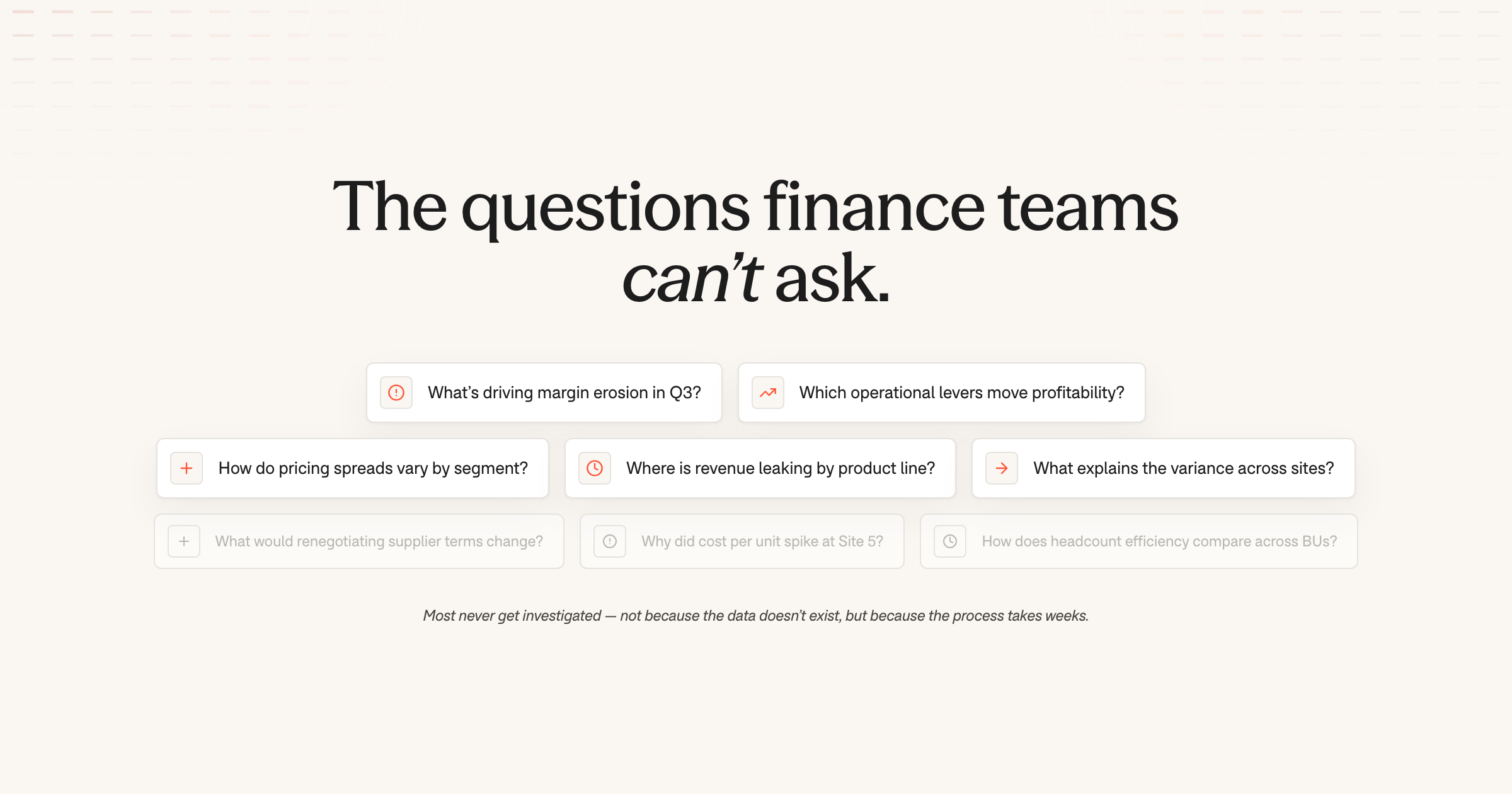
- Why did gross margin move in this entity, by customer and product?
- Which accounts explain the flux above the threshold we already use?
- Where does the forecast disagree with the ledger, on the same definition of the metric?
- What did price, volume, and mix each contribute at the plant or the region?
- Which vendors or SKUs account for the spend that was not in the plan?
Margin analysis covers the first and fourth. Budget versus actuals covers the forecast comparison. Root-cause analysis covers the flux. They are separate pages because a buyer searching for one of them needs that workflow, and they belong to the same finance automation practice.
Why these questions get stuck
The ERP is a system of record, not a system of explanation. A correct journal does not name the driver. The warehouse model might, if someone maintained the join. The spreadsheet definitely tried to. None of those facts is a reason to open a ticket every time a plant misses.
Sapien connects to the systems the question already depends on. The integrations directory lists them, including NetSuite, SAP, and the warehouses teams use beside the ledger. The implementation path, including the decision to start with one question, is AI implementation for finance.
What "without a ticket" looked like at Blink
Blink's financials were in NetSuite, commercial data in Salesforce, and charger activity in a custom warehouse. A question about whether a set of chargers made money crossed all three. The Blink Charging case study describes the CFO's constraint directly: he had implemented six ERPs and was not waiting through another 12-to-24-month program to see charger-level economics. The published result on one seasonal group was about a 40% margin uplift after the team could see the economics and act.
Where to go next
Read why company context beats a generic finance model for what has to be true before those questions come back with your definitions rather than a textbook's. To ask one of them on your data, book a demo.