Finance use case
AI Implementation for Finance
Implement AI on a finance workflow the team already runs, with the definitions and the source systems checked before the first close.
This page is for the finance leader who has been asked to 'implement AI' and does not want a pilot that never reaches the close. Sapien is implemented with the finance team, on their ERP and the files they already trust. There is no separate services catalog and no requirement to replace the ledger first.
The short answer
An AI implementation for finance is a scoped rollout: connect the systems that hold the numbers, agree the definitions those numbers use, validate one recurring workflow against a period the team already closed, and only then let more people ask questions.
Why this problem persists
The mandate arrives before the workflow does
Boards ask for an AI plan. The team that will live with the tool still has a close to finish. An implementation that starts from the tool, rather than from a workflow the close already depends on, stalls in procurement.
Data-readiness projects delay the first useful answer
Finance can already work in the current systems. Waiting for a perfect warehouse before anyone answers a margin question turns the implementation into another integration program.
A demo on sample data does not survive the chart of accounts
The failure shows up when the first real question uses the company's own cost centers, eliminations, and product names. If those were not part of the implementation, the team goes back to the spreadsheet.
Why Excel and BI tools fall short
A tool rollout is not the same as a close rollout
Training people on a new interface does not tell them whether margin in the tool matches margin in the board deck. The implementation has to compare the two.
Handing the project to IT alone drops the definitions
The joins can be technically correct and still miss the rule a controller applies for accruals, freight, or a customer program. That rule has to be part of the implementation, not a footnote.
Broad pilots create nothing the next close can reuse
A workshop that covers every possible use case usually leaves no workflow owned by a person who will run it on day 20 of the month.
How Sapien approaches the problem
Start with one question the close already asks
Pick a workflow with a known pain and a known answer from a recent period: a variance bridge, a margin walk, or the management report. That gives the team something to check the implementation against.
Connect the systems the workflow already uses
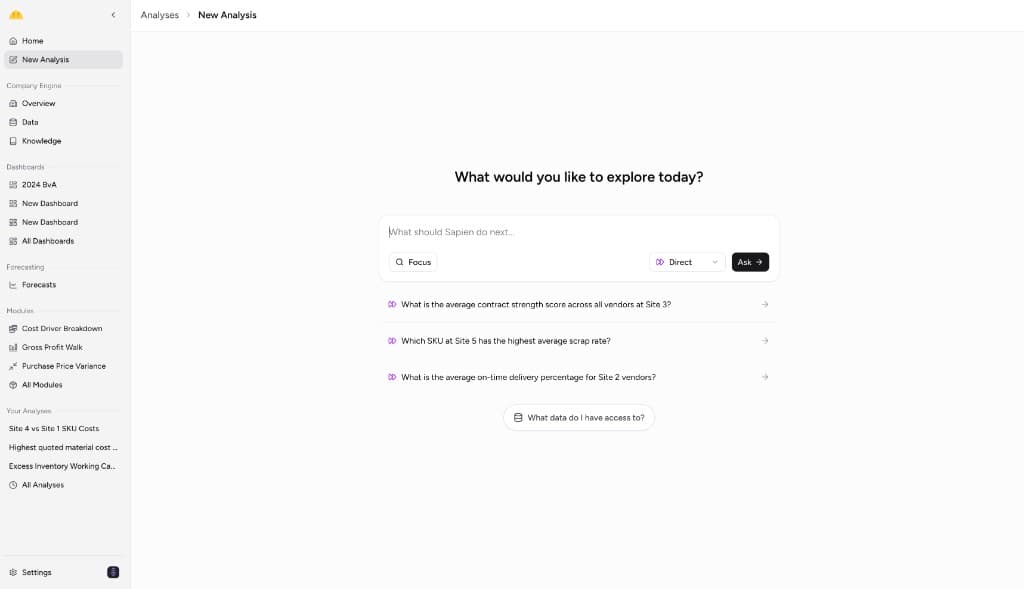
Sapien connects to ERPs, warehouses, and spreadsheets. The implementation maps the tables and files behind the chosen question, including the awkward joins, instead of waiting for a new data model.
Validate the definition with the person who signs the number
Finance reviews the sources, filters, and assumptions on the first runs. Corrections become part of the company context, so the next period does not restart the argument.
Real finance questions teams ask
These are the kinds of high-intent questions finance teams ask when they are evaluating whether a workflow can move from static reporting to repeatable, trusted analysis.
Week 1: which system holds the revenue and cost lines for the margin bridge we presented last month?
The implementation starts by naming the sources behind a package the team already shipped.
Week 2: rerun last month's bridge and show every place the definition differs from the deck.
Differences are the point of the check. The team decides which definition is the one the workflow should keep.
After the first close: who else can ask a follow-up without exporting the file?
Expansion happens after one workflow is trustworthy, not before.
What outcomes improve
A first workflow the close can actually use, checked against a period the team already knows.
Definitions that stay with the company when the person who built the spreadsheet is out.
A wider rollout that starts from a working analysis instead of a slide about AI.
How finance teams use Sapien in practice

AI Implementation for Finance
“Sapien reduces my workload answering important but low enterprise impact questions as a team of one. Now shop leaders aren't beholden to a static daily report.”

SVP of Strategy and Analytics
Want similar results?
Book a demo and see how Sapien would run this workflow on your data.