Finance use case
Financial Reporting Automation
Stop rebuilding the same close packages, charts, and commentary. Encode recurring reporting in workflows that are consistent, on time, and traceable to source data.
Every period, finance reassembles a familiar set: actuals, bridges, MBR and board slides, and follow-up workbooks. The issue is not whether the team is capable; the issue is how much of that work is still manual, offline, and impossible to hand off cleanly.
Why this problem persists
The reporting calendar never shrinks
Close, reforecast, board, segment reviews, and audit responses stack on the same people. The team spends the window copying numbers instead of improving the narrative and the forecast.
Static decks and PDFs are dead on delivery
When leadership asks a follow-up question, finance often has to reopen the workbooks behind the report and rebuild, which delays decisions and undermines trust in the first answer.
Rework and tribal knowledge are operational risk
Key files live on one analyst’s laptop, last month’s model has a new tab nobody documented, and nobody wants to be the one who sent the wrong number to the board.
Why Excel and BI tools fall short
Automation without analytical depth just moves the bottleneck
Legacy reporting tools can refresh numbers, but they do not help finance explain the drivers, reconcile exceptions, or produce commentary that is tied to the underlying data.
A patchwork of EPM, BI, and email is not a single reporting system
When the board deck, the forecast file, and the data warehouse are disconnected, the team re-types reconciliations and opens five systems to answer one follow-up question.
Regulatory and investor expectations on lineage are only increasing
Stakeholders do not just want a chart; they want a defensible line from a headline number to the source transactions, especially after a restatement or a tough quarter.
How Sapien approaches the problem
Encode the recurring reporting loop as a workflow
Turn the variance summary, package updates, and segment narrative into workflows that run the same way every month with a clear, auditable path for exceptions.
Connect commentary to the evidence behind the number
Sapien’s layer ties the explanation to the data so updates are not a separate, disconnected writing exercise.
Give the business a live path for follow-up questions
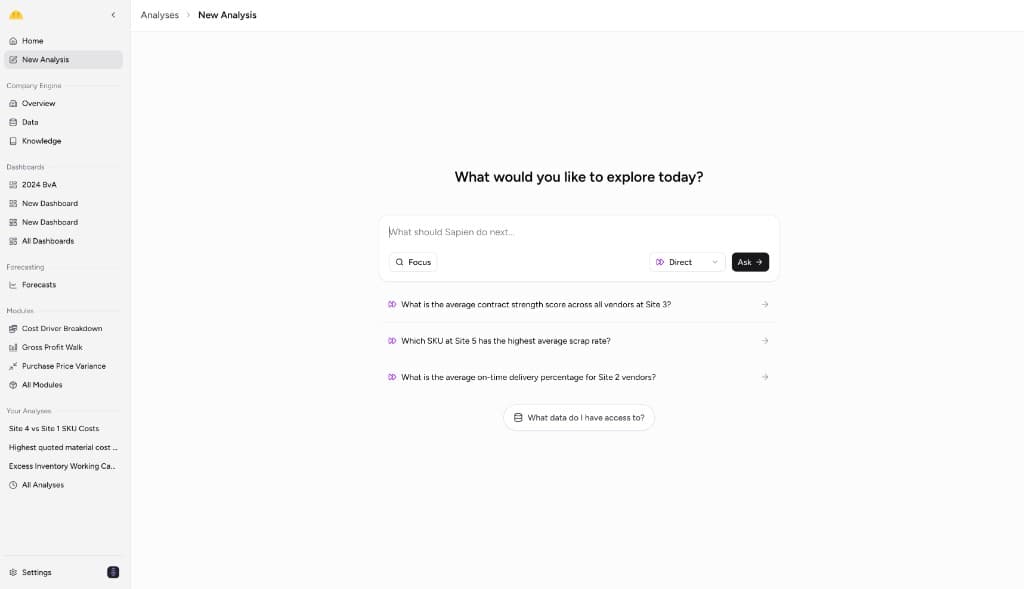
Leaders and operators can request drill-downs in plain language without re-opening the month-end war room, within the same governed analytical layer.
Real finance questions teams ask
These are the kinds of high-intent questions finance teams ask when they are evaluating whether a workflow can move from static reporting to repeatable, trusted analysis.
Run the month-end summary by segment for March 2026, highlight the top positive and negative P&L movements, and produce draft board bullets with the largest drivers quantified.
Sapien assembles the reporting slice, ranks material movements, and drafts defensible text tied to driver-level data.
Generate the weekly business review for retail operations: actuals versus plan, the three biggest callouts by region, and a link trail for any line over $200K variance.
Sapien automates a repeatable MBR package while preserving traceability for the CFO team to review before distribution.
Prepare a reporting-only summary for the audit committee: revenue recognition movements, the top five opex accrual changes, and supporting order-level references.
Sapien packages finance-native reporting for governance audiences with a clear evidence path behind each line.
What outcomes improve
Reclaim time on the calendar for analysis instead of re-keying the same report.
Make board, MBR, and close packages consistent, timely, and traceable to source data.
Scale reporting capacity as the business and reporting demands grow without scaling manual chaos.
How finance teams use Sapien in practice

Financial Reporting Automation
“Sapien reduces my workload answering important but low enterprise impact questions as a team of one. Now shop leaders aren’t beholden to a static daily report. They can view their business over any span of time, which is invaluable.”

SVP of Strategy and Analytics
Want similar results?
Book a demo and see how Sapien would run this workflow on your data.