
Transaction-Level vs Summary-Level AI: Why Finance Teams Need Granular Data
Most finance AI tools work with aggregated data and can't explain root causes. Transaction-level AI traces every insight to the exact transaction. Here's why that matters.

Ron Nachum
Sapien
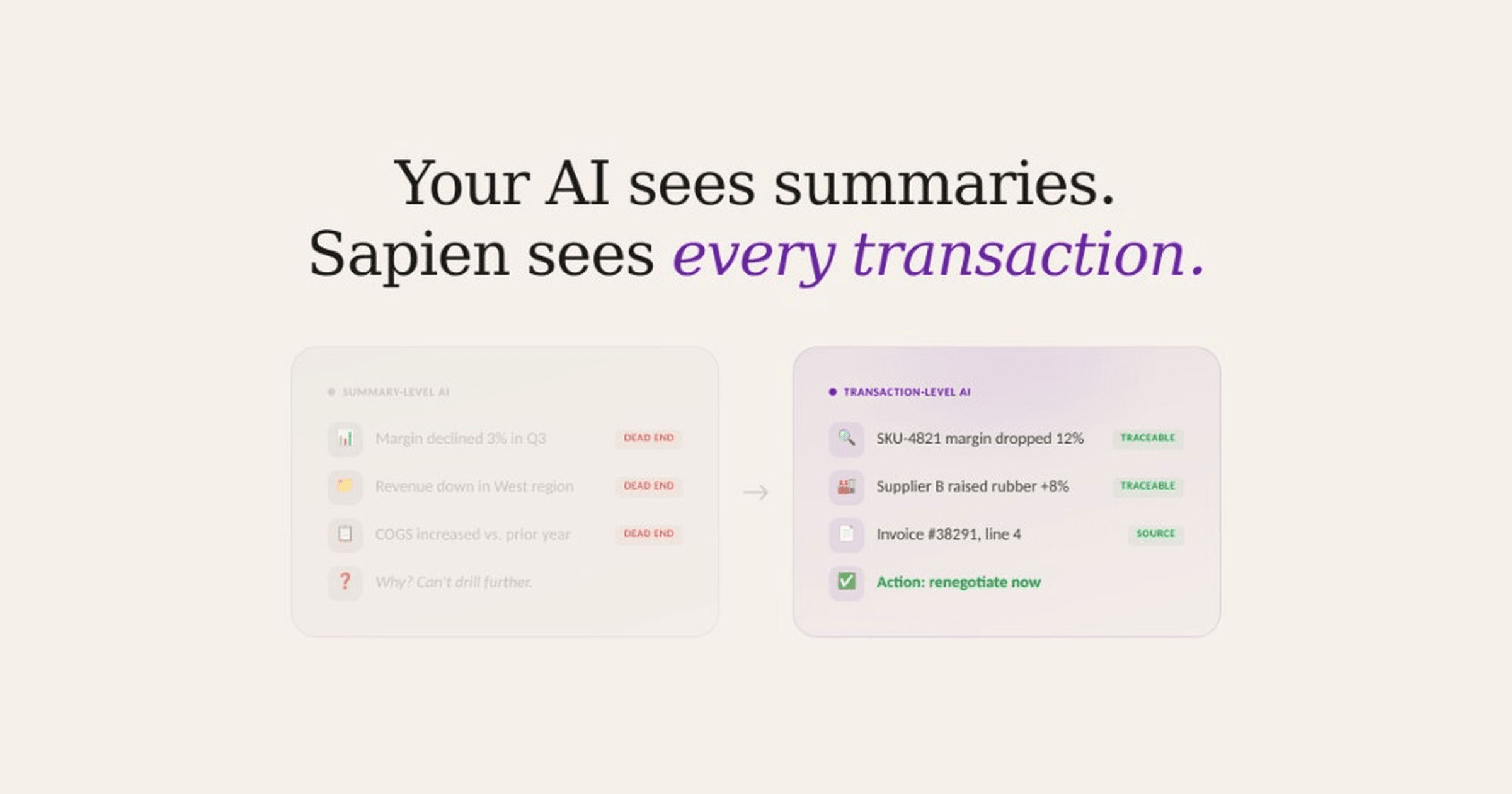
Most finance AI tools can tell you your margin declined. They can't tell you which SKU, which customer, or which transaction drove it. That gap is the difference between knowing something happened and being able to do something about it.
The Problem With Summary-Level Finance AI
Most AI platforms for finance work with aggregated data. They analyze monthly revenue summaries, rolled-up cost reports, and high-level P&L views. These are outputs of analysis that humans already performed: numbers already organized into presentable formats.
This creates a fundamental limitation for finance teams. When AI tells you margin declined 3% in Q3, it's working from the same summary reports a human analyst would use. It can spot the trend but it can't explain the root cause. Which products drove the decline? Which customers? Which specific transactions or activities tipped the balance? Summary-level AI has no visibility into those details because the data was already rolled up before the AI analyzed it.
The question "why did this happen?" hits a wall after two or three levels. You can ask what changed. You might get an answer about which region or product category shifted. But you can't drill down to the individual transaction that caused it, because that transaction was aggregated away before the AI ever accessed the data. This is a key reason why AI gets smarter and dashboards don't.
What Gets Lost When AI Works With Aggregated Data
Summary-level financial data bakes in human interpretation. Someone decided how to categorize transactions, which costs to allocate where, and what belonged in which bucket. Those decisions might be correct. They might also reflect outdated assumptions, manual errors, or shortcuts taken when the data was originally processed.
Real-world example: One manufacturer had a bill of materials file over a gigabyte in size. The file was so large that the finance team simply stopped refreshing it. Their latest version was 18 months old. The company was making margin decisions based on financial data that hadn't been updated in a year and a half. Not because the team didn't care, but because working with the raw file was too cumbersome for traditional analysis tools.
When finance AI works from pre-aggregated summaries, it inherits whatever biases or errors exist in that aggregation process. It can't catch upstream mistakes because it never sees the original transactions. It can only work with what it's given.
How Transaction-Level Analysis Changes Financial Operations
Transaction-level analysis means AI works directly with raw financial data: individual GL entries, invoice line items, specific parts, activities, and transactions. There's no aggregation layer and no human interpretation between the source system and the analysis.
This changes what AI can verify for finance teams. When a number looks wrong, you can trace it back to the exact transaction that produced it. When margin shifts, you can identify not just which product category but which specific part, purchased from which supplier, at which price point, drove the change. This level of verifiability is critical for CFO trust.
For the manufacturer with the 18-month-old bill of materials, connecting AI directly to their systems meant working with full activity-level and part-level data. The analysis that was too laborious to do manually now runs autonomously. The finance team doesn't spend weeks after month-end trying to figure out what happened. They get real-time visibility into which parts to renegotiate with suppliers, which activities are consuming too much time, and where to focus capacity across the business.
The difference isn't speed. It's that the financial analysis can now happen at all.
From Reactive Reporting to Proactive Financial Decisions
Summary-level analysis keeps finance teams in reactive mode. You close the month, wait a week for reports to finalize, spend another few weeks figuring out what drove the variance, and by then you're six weeks past the event you're analyzing. You're always looking backward at historical financial data.
Transaction-level granularity compresses that timeline and changes what questions finance teams can ask. Carlex spent years analyzing quote profitability at a high level with a team of 30 people. They could tell whether quotes were profitable or not, but only quarterly, and only at the quote level. Transaction-level AI analyzed the same data at the individual parts level and identified that rubber price fluctuations were making specific quotes unprofitable. The company could now renegotiate with suppliers proactively, not months after margin had already eroded.
&pizza had a flash report that told operators whether sales were up or down each morning. That was it. Transaction-level analysis let them see that an individual location's sales decline was driven specifically by a drop in third-party delivery orders. The operator could run a promotion on Uber Eats that day, not wait until the monthly review to discover the problem.
The timeline changes. The decisions change. Instead of asking "what happened last month?" finance teams start asking "what should we do today?"
How to Evaluate AI Platforms for Transaction-Level Capability
When evaluating AI platforms for finance, if the platform requires pre-processed summaries, aggregated reports, or cleaned datasets, it will be limited to surface-level financial analysis. It can identify trends, but it can't explain root causes or trace conclusions back to specific transactions. It will tell you what happened but won't tell you what to do about it.
AI platforms that work at the transaction level can do both. They surface the insight and show you exactly which transactions, activities, or line items drove it. That traceability is what makes financial analysis actionable.
The other advantage is flexibility for growing finance operations. When your business changes, when your chart of accounts shifts, when you add new cost centers or reorganize divisions, transaction-level AI systems adapt because they're working from the source. Summary-level systems break because the aggregation logic that fed them no longer matches how the business operates. Understanding how AI learns your business context is key to evaluating this capability.
Making the Shift to Transaction-Level Finance AI
Most finance teams are stuck answering "what happened?" They know they should be answering "what should we do?" but the data infrastructure doesn't support it. Summary-level analysis is fast to implement but limited in what it can deliver for financial operations. Transaction-level analysis requires more upfront work to connect to source systems, but it's the only way to move from explaining what happened to deciding what happens next.
For finance teams evaluating AI platforms, the question isn't just whether the tool can produce insights. The question is what level of financial data the tool actually works with, and whether that granularity is sufficient to drive the decisions you need to make. Start with a real problem, not a technology demo.