
Why AI Agents for Finance and Operations Require Partnerships
AI analytics for finance and operations teams demands a partnership model, not point solutions. Learn why leaders are rethinking how they buy AI.

Ron Nachum
CEO, Sapien
Enterprise buyers tend to evaluate AI analytics for finance and operations the same way they evaluate traditional software. Define the problem, pick the point solution that solves it best, implement it, move on. That model worked for decades of enterprise software purchases. It breaks down completely with AI.
Why the Old Software Model Made Sense
Traditional software was deterministic. Teams bought it, configured it, and it ran. The workflows were fixed. The implementation was a one-time project. Once the system was set up, it operated without requiring ongoing partnership with the vendor.
This approach made sense because the software itself was static. A financial reporting system deployed in 2015 worked the same way in 2020. The value didn't compound over time — if anything, it depreciated as business needs evolved and the software stayed frozen.
Why Point Solutions Fail for AI Agents in Finance and Operations
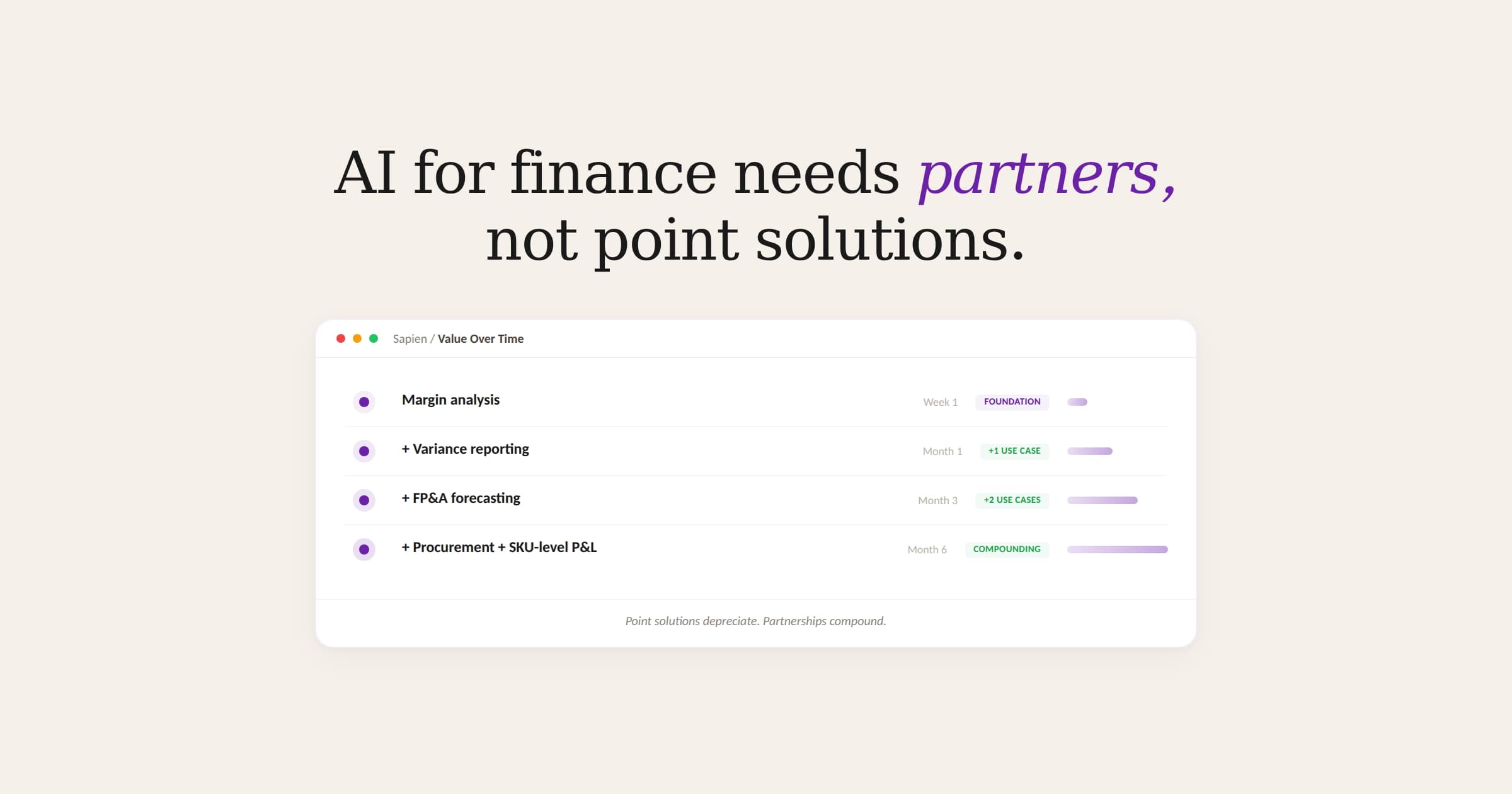
AI systems for finance and operations work differently. They learn your business over time, which means the value compounds rather than depreciates. The first use case — whether it's margin analysis, variance reporting, or FP&A forecasting — requires loading data and building initial understanding. But once that foundation exists, adding use cases becomes fast and inexpensive.
The underlying models improve continuously. What one generation of AI couldn't do reliably, the next handles routinely. Without a partner abstracting that complexity and routing your queries to the best models as they evolve, you're either constantly rebuilding your AI analytics solution or falling behind.
The technology moves fast enough that buying a static tool means you're already outdated. The traditional purchasing model wasn't designed for this kind of compounding value.
The Pitfalls of Current Approaches to AI Analytics for Finance
When finance and operations teams recognize that traditional software isn't sufficient, they typically turn to two alternatives: consultants or internal builds. Both fall short.
The Consultant Trap
Consultants seem like the obvious answer. Bring in external expertise, scope a project, get a custom solution. The problem emerges after the engagement ends. What remains is often a point solution that fixed the immediate problem but doesn't scale. It cost significant money, and measuring long-term value is difficult because the solution was designed per the consultant's methodology — not necessarily what's best for the business moving forward.
There's also a granularity problem. Consultants work with summarized or aggregated data to make engagements manageable. They can't achieve the transaction-level detail that comes from AI agents plugging directly into ERP, GL, and source systems. When a consultant tells you margin declined in the Northeast, they can identify the trend. They can't trace it back to the specific SKUs affected by tariff changes or show you the exact customer and product mix driving the variance. That level of granularity requires direct system access that consulting engagements rarely provide.
The BI Tool Ceiling
BI tools like Power BI solve the granularity problem but create a different one. They can surface everything in your data, but it takes weeks to build the views, and once built, they're static. You get detail without synthesis — information without actionable insight. For FP&A teams who need to move from data to decision, that gap is critical.
The Internal Build Trap
When teams hit the limitations of consultants and BI tools, building internally seems like a logical next step. If consultants lack granularity and BI tools lack intelligence, why not build your own AI agent that has both?
One company we worked with spent three years building a proof of concept for an internal agent to analyze data across a handful of their systems. A comparable implementation with a verticalized AI analytics platform took four weeks and covered all their systems — not just a subset.
Building a functional AI agent for finance requires expertise in two distinct domains: the technical architecture of AI systems, and the specific workflows of finance and operations functions like FP&A, strategic finance, and procurement. Companies rarely possess this combined expertise internally — and even if they do, it's not the best use of resources.
The deeper problem is architectural. Without a proper data understanding layer, internal builds end up cobbling together fragments of data in ways that are difficult to verify and prone to errors. The foundation matters more than the interface, and building that foundation from scratch is harder than it appears.
What a True AI Partnership Looks Like for Finance Teams
The right model for AI analytics in finance and operations isn't consulting, and it isn't traditional software. It's partnership — but that term needs a concrete definition.
Consulting is reactive. Companies hire consultants when something is broken, not to get a continuous pulse on what could be better. The engagement is scoped, delivered, and closed. Partnership is proactive. It means building a system designed to surface opportunities before they become problems and to improve continuously as the business evolves.
Sapien's AI analytics platform puts this into practice. The platform achieves transaction-level granularity that consultants can't reach while providing the synthesized, actionable views that BI tools can't generate. When you ask why gross margin declined, the system doesn't just identify the trend — it traces the variance back to specific transactions, shows you which SKUs and customer segments drove the change, and surfaces the assumptions it used to get there. You can verify every step because the reasoning is transparent, not locked in a consultant's model.
As Sapien's personalization layer evolves, the platform adapts to each user's role and function. The SKU team's view surfaces anomalies in month-end accruals analysis. The strategic finance team gets executive summaries prioritized by impact. The FP&A team sees variance drivers and forecast adjustments. Same underlying AI agent, different views tailored to what each person actually needs.
How to Evaluate AI Agents for Finance and Operations: A New Framework
Evaluating AI analytics platforms for finance and operations means asking different questions than evaluating point solutions.
"Does it solve my problem?" → "Does it create a foundation I can build on?" Your first use case matters, but the real value is in how easily the second, third, and fourth use cases expand from that foundation.
"What does implementation cost?" → "What does expansion cost?" The initial deployment cost is less important than the marginal cost of each additional use case across finance and operations.
"What features does it have?" → "Does it keep up with me?" The platform should handle model updates and evolving business needs without requiring you to rebuild or rethink your approach.
"Can it show me data?" → "Can it trace to the transaction?" True AI analytics for finance and operations must go beyond aggregated summaries. You need to trace any analysis back to the specific transactions that drive it.
"Does it inform?" → "Does it act?" The platform should tell you what to do, not just show you what happened. AI agents for finance and operations should generate actionable insight, not just dashboards.
"One-size-fits-all?" → "Personalized by role?" Different functions — FP&A, procurement, strategic finance, operations — need different views of the same underlying intelligence.
The answers to these questions tell you whether you're buying software that will need replacing in two years or building AI infrastructure that compounds in value.
Build AI Infrastructure That Compounds
Months into implementation, buyers who chose point solutions are back in procurement looking for the next tool. Finance and operations teams who've embraced AI partnerships have expanded to use cases they didn't anticipate when they started.
Point solutions work for point problems. But if the goal is transforming how finance and operations teams interact with data and make decisions, the model needs to match the ambition. That means partnership — and that's exactly what AI agents for finance and operations are designed to deliver. Why explaining what happened is not enough shows how that changes business decisions.