What Traceable Finance Analytics Means
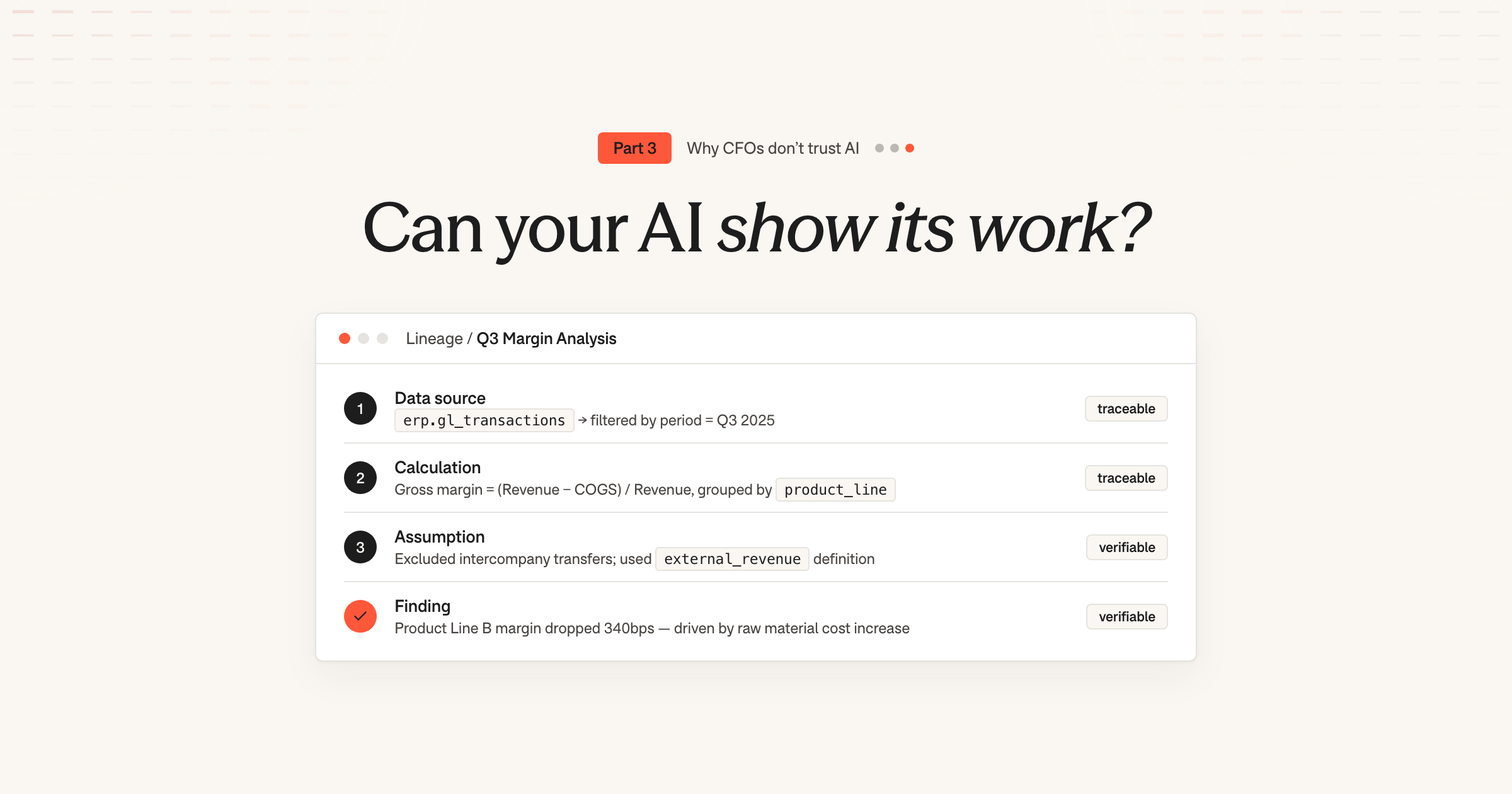
A definition finance teams can use: an analysis is traceable when a reviewer can move from the sentence to the sources, filters, and definition that produced it.
The Sapien Team
Sapien
Finance teams already know what an unsupported number feels like. Someone asks "where did this come from," and the answer is a search through a workbook. Traceable finance analytics is the opposite of that search.
For a CFO, controller, or FP&A lead, the definition is concrete. An analysis is traceable when a reviewer can move from the figure in the commentary to the sources, the filters, the calculation, and the definition the company uses, without reconstructing the file.
Why the summary is not the trail
A dashboard that shows margin down 80 basis points has done the display job. The trail starts at the next question: which products, which customers, which plants, and which definition of margin. Root-cause analysis for finance is that workflow. Variance analysis is the bridge that should be rerunnable next month with the same trail.
Sapien's approach is to keep the trail with the answer. The longer engineering account is how we build trustworthy AI for CFOs. The buying version is verifiability: the calculation is done by tools a person can inspect, and the language model is not the place the arithmetic happens.
What a reviewer should be able to open
| Step | What is visible |
|---|---|
| Source | The system and the table or file the figure came from |
| Filter | The entity, period, product, or customer the question included |
| Definition | The company's rule for the metric, including what it excludes |
| Change | A correction a person made, kept for the next run |
If any row is missing, the number can still be right. It is not yet something a CFO should put in front of a board as if the path were settled.
A published case
Carlex's published story turns on this distinction. The summary bridge and the driver-level read disagreed by $12 million of EBITDA attribution. The team could examine the work, found a formula error in a long-lived spreadsheet, and then saw a profit opportunity of about $1.5 million that the usual analysis had not asked about. The Carlex case study is the narrative. The analytical point is that the correction was possible because the path could be inspected.
Where to go next
The next piece in this series is how a CFO audits an AI answer. The workflow hub is finance automation. To see a trail on your own close, book a demo.