Why Finance Teams Can't Ask the Questions That Matter
Finance teams sit on top of all the data they need to answer complex business issues, but they can't actually use it. Here's why the bottleneck persists — and what we've seen work differently.
Ron Nachum
CEO, Sapien
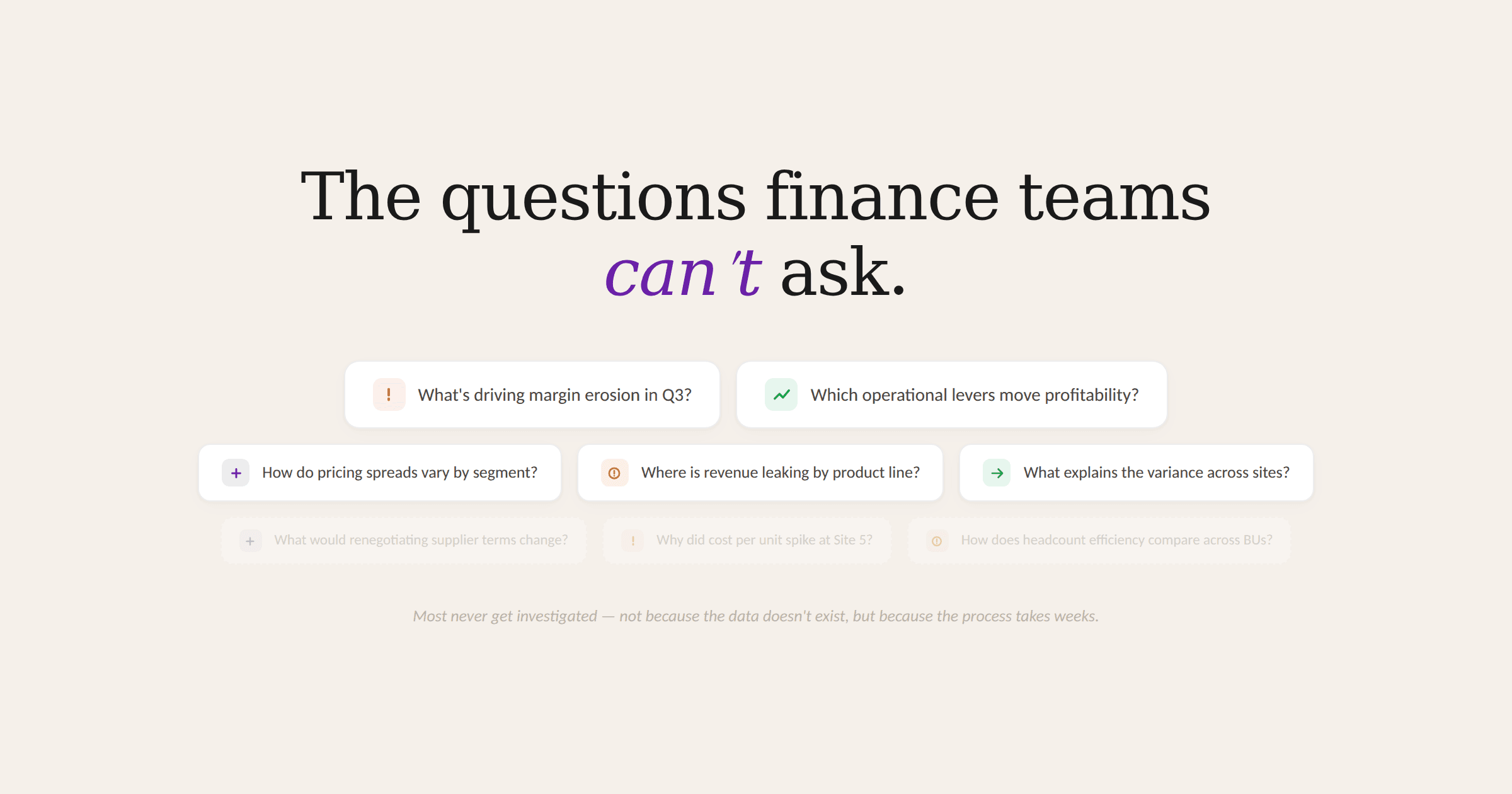
Finance teams sit on top of all the data they need to answer complex business issues, but they can't actually use it. Even with modern BI platforms and advanced IT support, they should be able to get answers about their operations quickly. In practice, though, most analyses take weeks — so many of these issues never get investigated at all.
We've seen this pattern across dozens of companies. An analyst wants to understand pricing dynamics across customer segments, or a CFO needs visibility into margin drivers by product line. A VP of FP&A wonders which operational changes would move the needle on profitability. These are fundamental business questions that key decision makers need answered in order to make informed and deliberate decisions. But the process to answer them is so burdensome that teams often abandon the query before they get the answer.
The Back of the Line
Finance and operations teams don't generate revenue when they're stuck managing reporting cycles and compliance instead of focusing on strategic analysis. This puts their requests at the back of IT's queue, even though the insights they could uncover — if given the capacity — would drive growth and profitability. A sales team asking for CRM modifications or a product team requesting analytics infrastructure gets prioritized, while a finance team asking for a new dashboard or data export turns into a multi-week project, if IT has capacity at all.
The deeper issue is why finance needs IT in the first place. Finance teams know which questions matter and IT teams know how to query databases. But very few people can do both.
This creates a dependency where every question requires translation. Finance explains what they need, IT interprets it into SQL queries and Excel exports, and finance validates the output. Each iteration takes days or weeks. And because finance teams can't explore data themselves, they don't know which questions are worth the effort of escalating to IT.
We worked with a portfolio company managing nine business units that prepared weekly investor reports for each unit. The finance team spent multiple days every week on this reporting cycle. When the reports were finished, they had no time left to analyze what the reports actually said or identify which levers could improve performance. Reporting consumed all available capacity, leaving no room for the strategic analysis that should actually drive business decisions.
The natural language promise of AI-powered analytics platforms should eliminate this translation layer, but most platforms still require technical configuration and data modeling before finance teams can ask questions directly.
Why Traditional Solutions Don't Work
Traditional business intelligence tools help with analysis, but they don't eliminate the bottleneck. Building a new dashboard still requires IT resources and technical specifications. Teams can visualize data faster once the infrastructure exists, but creating that infrastructure takes months.
Most AI-powered analytics tools promise self-service but deliver the same implementation burden as legacy systems. The software itself might cost $200,000, which feels manageable. Then companies discover they need consultants to configure it, IT resources to integrate it, and months of capacity from the finance team to validate outputs. The $200,000 pales in comparison to the opportunity cost of dedicating half the team to an implementation that pushes out other priorities.
IT teams aren't opposed to new technology but they're wary of systems that add to their workload without freeing capacity elsewhere. Especially for mid-size businesses with lean IT teams, they are busy enough without yet another integration, another set of permissions to manage, or another platform to maintain. The incentive structure makes IT cautious about adding tools, even when those tools would help the business. What IT teams need is capacity for the projects that actually require their expertise: infrastructure upgrades, security improvements, and system integrations.
What We've Seen Work Differently
Sapien is designed to reduce friction. Finance teams can ask questions in natural language without needing to understand exactly how data is structured or how to write SQL. This solves the "very few people can do both" problem. IT is still involved, helping set up secure connections and access to data sources. But within a day, the foundation is in place and finance teams can work directly with the system instead of routing every question through IT.
One customer's analysts had spent a month building a pricing analysis, examining spreads across different customer segments. During our initial demo, we loaded their data and ran the same analysis in three minutes. The analyst had identified two key insights. Sapien surfaced those same two insights and a third the analyst had missed. The value wasn't just speed. It was the shift from playing defense to playing offense. Finance teams could move from spending a month on a single analysis to running dozens of scenarios in real time, testing assumptions, and identifying strategic opportunities they'd never had capacity to explore.
We often raise in demos: "If you could ask your data anything, what would you want to know?" A manufacturer told us they wanted to understand variable contribution margin at the part-by-part level. Before Sapien, this required manually reconciling data from their ERP and quoting system. The team couldn't imagine this analysis was feasible given their current infrastructure. After connecting those systems, analyses that would have previously taken tens of thousands of hours became routine.
What This Enables
For the portfolio company managing nine business units, the shift was immediate. Weekly reporting went from a multi-day manual process to an automated workflow in Sapien. Capacity shifted from producing reports to analyzing them — identifying operational levers and testing scenarios. This is what the role should have been all along.
IT's role shifts too. Initial setup requires their expertise. They need to understand data architecture, establish secure connections, and ensure compliance. But the ongoing work happens between finance users and the system, without requiring IT intervention for every new question. This frees IT capacity for infrastructure projects and system improvements rather than fielding repetitive data requests.
Why This Matters Now
Every board and CFO is asking how AI fits into their operations. But the more important question is how it changes the way decisions get made.
The promise of AI in finance is restoring time and attention to the critical work of understanding what's happening in the business and deciding what to do next. Finance teams already sit on top of the most valuable data in the company. The opportunity now is to remove the friction that keeps them from using it and perform analyses at the speed decisions require.
— Ron Nachum & The Sapien Team