Why AI Gets Smarter And Dashboards Don't
Traditional BI tools don't learn. Most financial AI replicates the same limitation in a different form. Sapien's Company Engine is a fundamentally different architecture — one that compounds in value the longer you use it.
Ron Nachum
CEO, Sapien
Traditional business intelligence tools excel at calculation. They can slice data across dimensions, generate dashboards, and produce reports — but they don't learn. The logic that defined "unusual" in January is still the logic in June, even after the business, vendors, and operating context have changed.
AI-powered analytics promised to change this dynamic. But most financial AI replicates the same limitation in a different form, operating as sophisticated query engines that process data faster without learning about the business.
Sapien's approach is drastically different, centering on the Company Engine: a system that allows for continual, contextual learning. Rather than treating every question a user asks the platform as isolated, it accumulates knowledge about how a specific company operates, what its priorities are, and how it defines success with a human in-the-loop. This business understanding enables real-time analysis and data onboarding with deep, company-specific context.
The Company Engine is a fundamental architectural difference in how AI systems work with financial data. While traditional AI systems optimize for breadth, the Company Engine optimizes for depth — gaining intelligence about a specific business over time rather than staying generically capable across all businesses.
This distinction matters because speed without context produces incomplete analysis. Generic AI tools can process massive datasets at speed, but lack understanding of how a company's revenue recognition works or which metrics actually matter to company leadership. If an analyst creates a dashboard showing Q4 revenue increasing 15% QoQ, the natural follow-up question is "why?" But it's impossible to answer without context. Without understanding how those numbers relate to product mix, regional performance, customer segments, or seasonal patterns specific to that business, critical "why" questions hit a wall.
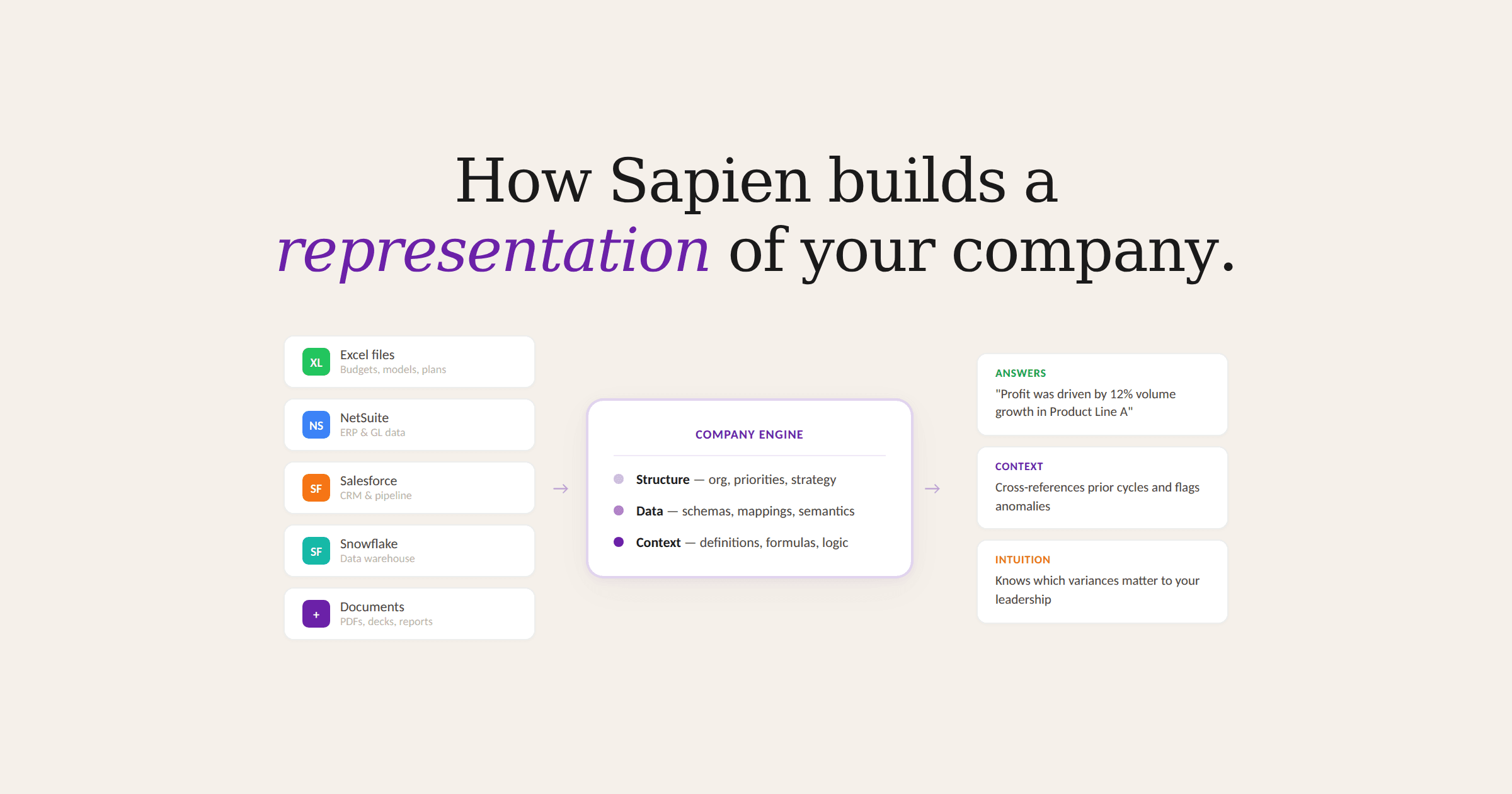
Sapien's Company Engine stitches together business context by building and maintaining three interconnected layers of business understanding.
Company Structure
The first layer captures what the business does, how it's organized, and what it prioritizes. When a finance executive asks about variance, the system goes beyond calculating which numbers changed and understands which variances are most urgent to flag based on key strategic priorities. When surfacing anomalies, Sapien learns from prior cycles which patterns required executive intervention and elevates those first, while deprioritizing noise that has repeatedly resolved without action. This is what we call bottom-line aligned analytics: analysis that seamlessly connects to business initiatives rather than treating all data points as arbitrary.
The Company Structure layer populates through automated analysis of company resources during the initial setup. It examines documentation, organizational charts, strategic plans, and existing reports to extract objectives and priorities. When users ask action-oriented questions ("How can we improve margins?"), the system references strategic priorities to frame responses. For granular queries about specific metrics, it focuses on relevant data without layering in strategic context.
Data Understanding
The second layer takes the data plugged into Sapien and maps the relationships between sheets, tables, and columns — including not just schema definitions, but semantic meaning.
Companies routinely reuse the same terms to mean different things. A distributor might have four columns labeled "costs" across different tables meaning raw material costs, shipping costs, overhead allocations, and fully-loaded cost, with each definition being used in distinct analytical contexts. "Month" might refer to fiscal period in one system, calendar month in another, and posting month after close adjustments in a third. Traditional systems require explicit configuration for each interpretation, while the Company Engine learns these distinctions through usage and historical analysis.
This layer eliminates translation gaps as finance teams are able to ask questions in their company's language and the system interprets correctly based on its continual learning, rather than generic business assumptions. As a result, teams can use Sapien for real analysis from day one without lengthy data migration projects, months of platform training, or external consultants, significantly reducing the opportunity cost of implementation.
The data understanding layer builds through iteration. It creates detailed descriptions of tables, columns, and relationships. User queries reveal implicit mappings and preferences that the system stores. For example, when a user asks Sapien to join an Excel spreadsheet to an ERP table via a shared part ID, the system stores this relationship and automatically applies it in future analyses involving either data source. Unlike traditional data catalogs that require manual documentation of every relationship, this layer updates automatically based on usage patterns. Corrections occur through natural language — users don't edit metadata directly. They just use data the way they think about it, and the system adjusts its understanding accordingly.
Context & Knowledge
The third layer stores definitions, formulas, processes, and business logic. Most finance systems handle raw data — Excel files and ERP exports — and final outputs like dashboards and 10-Qs. But they miss the middle: the unwritten rules, definitions, mappings, and judgment calls in analysts' heads that turn data into trusted reporting.
This layer stores that middle as explicit, reusable knowledge items: how segments are defined in practice, which accounts roll up together, how allocations work when metadata is incomplete, which formulas apply for management versus external reporting, where exceptions exist due to historical or structural decisions, and best practices for analysis within the business.
As teams use Sapien, the system surfaces gaps in this knowledge in real time. When results don't match expectations, Sapien traces its reasoning, identifies missing assumptions or rules, and proposes the knowledge item(s) needed to resolve the discrepancy. In a recent 10-Q workflow, a finance team noticed Sapien calculated segment revenue as $9.3 million when they expected $11 million. They stated the discrepancy and Sapien identified transactions that should have been allocated to that account but weren't specified in the original knowledge item. The system asked for confirmation to update the knowledge item, then applied it consistently going forward.
Over time, this becomes a living context layer. The result is faster analysis, fewer inconsistencies, and reporting that reflects how the business actually operates — not just how the data happens to be structured.
Putting the Layers Together
Consider a manufacturing company asking, "How can we improve gross margin at our Northeast plant?"
Company structure provides context by recognizing from documented priorities that the company is focused on optimizing a specific product family and improving this plant's 2026 performance over 2025. This allows for bottom-line aligned analytics and frames the direction of further assessment before any data is touched.
If six months earlier, the priority was cost reduction across all plants, this same question would have triggered comparative cost analysis instead. The system adapts to current priorities, not just available data.
Data understanding identifies relevant information. Among 75 tables across multiple databases, the system knows which columns contain the right cost data, how to join transaction tables to cost tables via transaction IDs, and where regional designations are stored.
Context and knowledge applies business-specific logic, understanding that margin for this company is calculated as revenue minus material costs and direct labor, but excludes overhead allocation. The system knows that SKUs starting with "NE-" are seasonal products sold only in Q2–Q3, which matters for interpreting margin trends.
The output of the three layers working simultaneously is analyses filtered by strategic priorities, using correct data sources, calculated using company-specific rules, and contextualized with seasonal patterns.
What This Enables
The Company Engine solves a context problem rather than a data problem — by continuously learning how a business defines its metrics, prioritizes decisions, and connects information across systems. As it is used, it adapts to changing goals the way a finance team does, enabling self-serve analysis in natural language with the correct definitions and hierarchies already understood.
By learning how Excel models, ERP transactions, CRM data, and databases relate through usage, it brings these sources together into a single, trusted system without manual integration. Unlike traditional BI or generic AI, which remain static over time, the Company Engine compounds in value — embedding institutional knowledge into the system and turning analysis into faster, more proactive insight.
— Ron Nachum & The Sapien Team