What Finance and Operations Leaders Should Look for in an AI Demo
Most AI demos weren't built with finance and operations in mind. Here's the evaluation framework that helps leaders move beyond surface-level impressions and assess whether a platform fits their needs at scale.
Ron Nachum
CEO, Sapien
"Show me a demo" is the first thing every finance and operations leader says when evaluating AI platforms. They want to understand capabilities, test functionality, and assess whether a platform can handle the complexity of their data environment.
But most AI demos weren't built with finance and operations in mind. They default to generic dashboards and surface-level summaries that don't reflect what finance and operations teams actually want: tracing numbers back to source systems, pressure-testing assumptions, and drilling into the "why" behind a variance. When demos skip over that complexity, they leave leaders guessing about what the platform can actually do once it's in production.
AI demos also present a unique challenge. Unlike traditional enterprise software with predictable outputs and fixed workflows, AI systems adapt, learn, and operate probabilistically. This flexibility is powerful, but it also means not all demos are created equal. Knowing what to look for matters.
At Sapien, we think the demo should work as hard as the platform. That starts with a strong evaluation framework — one that helps finance and operations leaders move beyond surface-level impressions and ask the right questions to confidently assess whether a platform fits their needs at scale.
What Makes An Effective Demo
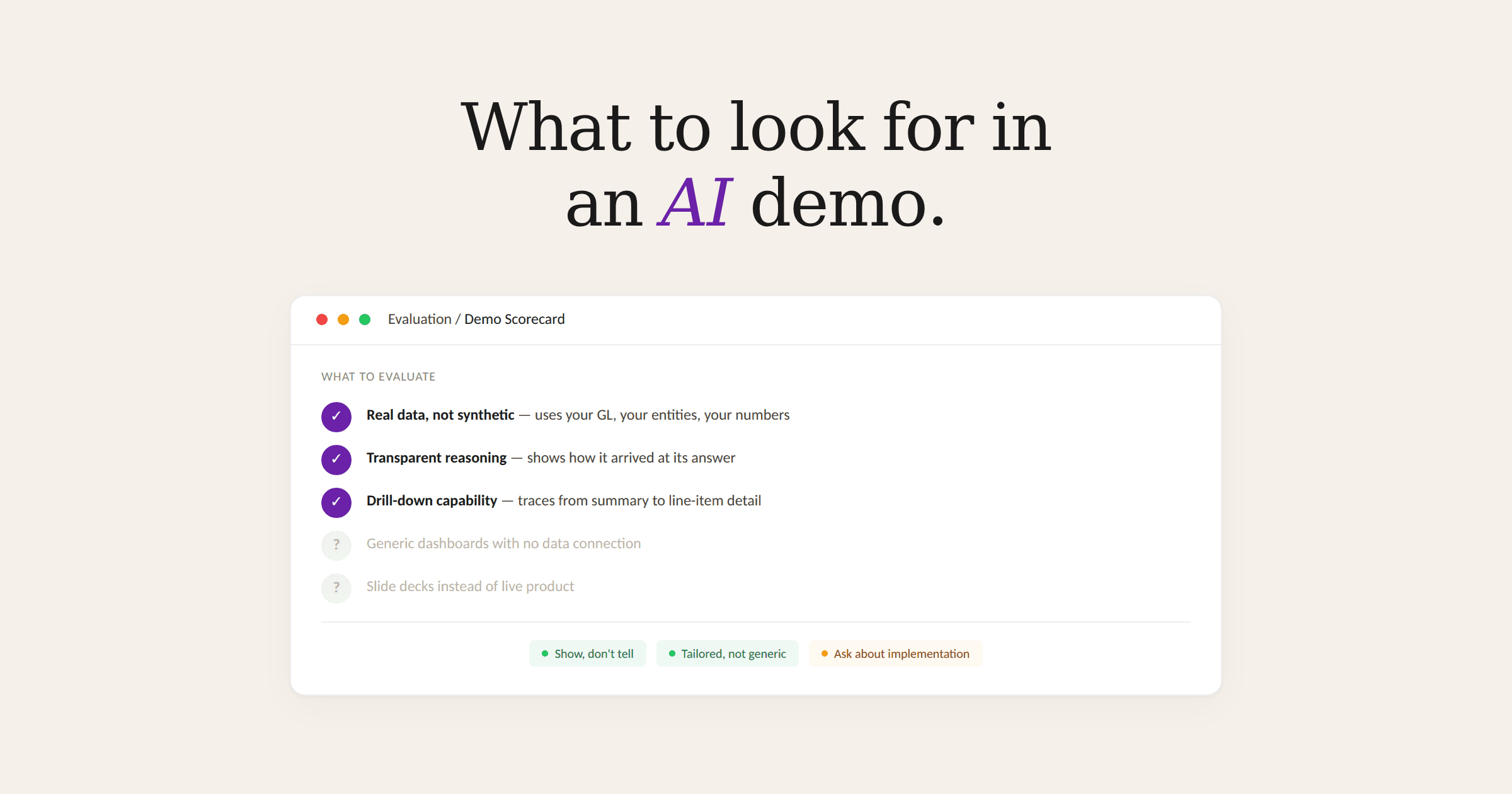
Effective demos demonstrate actual product functionality using realistic data scenarios. The platform should handle questions in real time (revenue breakdowns, margin drivers, cost allocations), surface insights without extensive pre-configuration, and expose its reasoning process transparently. Finance and operations leaders should see how the system interprets queries and arrives at conclusions.
The strongest demos go beyond narration; they show the product in action. Rather than relying on slide decks or hypothetical use cases, they run actual analyses and walk through real outputs. They address data readiness openly and give buyers a clear picture of what implementation involves. For finance teams evaluating platforms, this matters more than most — if the demo can't handle the messiness of real GL data or multi-entity structures, that's a signal worth paying attention to.
A helpful rule of thumb: prioritize demos where vendors show you the platform rather than tell you about it. If core functionality is visible from the first conversation, it's a strong signal that the platform can deliver at scale.
What to Look for During a Demo
One of the most valuable things a demo can reveal is how much preparation a platform needs before it delivers results. A strong demo shows not just the end output but gives finance and operations leaders a realistic sense of the implementation timeline — including configuration, data readiness, and validation requirements. The more transparent a vendor is about these steps upfront, the smoother the path to production.
It's also worth paying attention to how the platform handles ambiguity. If a buyer asks a query about "revenue," does the system surface its assumptions (recognized revenue, booked revenue, collected revenue, etc.) and let you correct them in real time? If an operations lead asks about "fulfillment rate," does it clarify whether that means units shipped, orders completed, or on-time delivery? Platforms that clarify their reasoning during a demo are showing the kind of transparency that scales well in production.
The strongest demos are tailored, not generic. Rather than walking through a broad set of capabilities, they start by asking what problem the team is trying to solve and then demonstrating that specific functionality. For finance and operations teams, that might mean showing how the platform handles a specific close process, reconciliation workflow, or supply chain analysis. A focused demo signals that the platform is built to address real use cases without heavy customization.
For platforms handling sensitive financial and operational data, the demo is also a window into architectural decisions. Teams should note how the system responds to unexpected questions. Does it provide transparency into what data it accessed and how it arrived at its answer? A platform that can clearly explain its own reasoning in a demo environment is one that's built for auditability at scale.
What Teams Should Demand
Teams should insist on seeing their own data in the system — not synthetic examples or pre-built demonstrations. For finance, that means actual GL data, real journal entries, or live transactional records. For operations, it means production data, inventory feeds, or fulfillment logs. This is what reveals whether a platform can handle real operational complexity, not a curated dataset.
They should ask vendors to demonstrate drill-down capability. Surface-level dashboards only tell part of the story. Effective systems allow teams to interrogate underlying data and trace calculations back to source systems — even in the demo. If a finance lead asks why margin dropped in Q3, can the platform walk from the summary all the way down to the line-item detail? If an operations lead flags a spike in lead times, can it trace back to the root cause across systems?
Teams should consider whether the platform solves a specific problem or just adds another tool to the stack. The best implementations start with one painful process that demands significant manual effort or creates recurring bottlenecks — a monthly close that takes too long, a demand forecast that lives in disconnected spreadsheets, an inventory reconciliation that requires days of manual work. If a platform can't meaningfully improve that initial use case, it's worth asking whether broader expansion will deliver the value you need.
And critically, teams should ask about implementation timelines directly. AI should accelerate workflows, not extend them. Platforms that can deliver initial value quickly — even before a full rollout — demonstrate the kind of architectural flexibility that supports long-term scalability.
How Sapien Addresses These Gaps
Sapien's architecture eliminates most pre-demo preparation. We spend minimal time preparing demos. The engineering work that makes this possible happened months ago, not the night before the call. We built the platform to ingest data and build understanding automatically, which means demonstrations show actual capability within minutes rather than weeks.
The platform exposes its reasoning at every step. When Sapien generates an output during a demo, buyers can watch in real time as the system identifies which tables contain relevant data, determines which columns to join, and surfaces the assumptions guiding its analysis. This isn't a post-hoc explanation from the vendor. It's visible as the analysis runs.
If the system makes an incorrect assumption, the misunderstanding becomes apparent immediately. Buyers see Sapien adjust its interpretation and store that correction for future queries. The transparent reasoning that buyers observe in the demo is exactly what happens in production.
Making Better Evaluation Decisions
The best AI demos don't just showcase what a system can do today — they give finance and operations leaders confidence in how it will perform over time.
Teams should look for platforms that can show what the system delivers in month one, and how it adapts in month three when the chart of accounts changes, new cost centers come online, operational workflows shift, or the team starts asking questions nobody anticipated during implementation. A platform built for real-world conditions should be able to demonstrate that resilience even in a demo setting.
A good AI demo answers questions. A great one shows customers how the system reacts when the questions change.